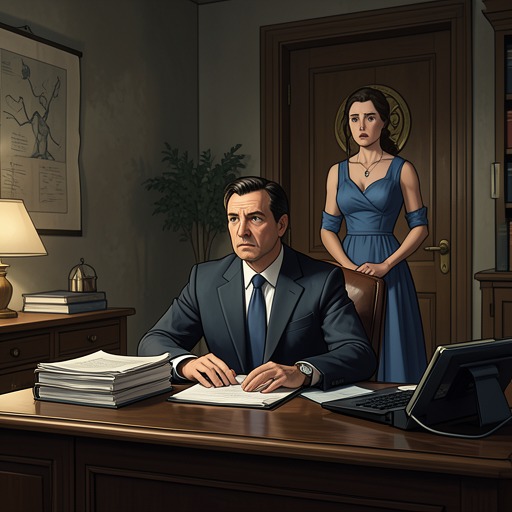
J.W. Wells & Co. headquarters (70 St Mary Axe)
The Portable DoorJ.W. Wells & Co. headquarters (70 St Mary Axe) is the London workplace where Paul Carpenter and Sophie Pettingell encounter the company’s peculiar everyday arrangements and where ordinary office space repeatedly opens onto supernatural events. Its reception, corridors, office doors, and desks are not simply background: they regulate who can enter or leave, expose signs of disturbance, and make the headquarters a threshold between routine employment and the uncanny.
Setting and Spatial Organization
The address becomes explicit when Paul arrives by taxi at 70 St Mary Axe. The journey seems to take almost no time; after he gets out, the taxi departs and he finds himself outside the headquarters, unsure how to enter. A goblin opens the door only about twenty degrees and beckons him through. As they pass, the goblin bows deeply. The brief, carefully staged crossing makes the entrance a point of contact with a workplace whose access is already governed by unfamiliar customs.
Inside, reception is a recurring point of orientation. Paul and Sophie are escorted there and find Dennis Tanner waiting by the door, with a key in the lock on the inside. On another occasion, they return to reception before heading towards their office to collect their coats. Tanner urges them to hurry; after they retrieve the coats and cross the corridor back, the door slams behind them with a bang. Their departure is physically abrupt, even though Tanner does not actually push them out.
The route through the building also connects reception to Tanner’s office and to a photocopy room. When Paul and Sophie investigate a disturbance, they first try Tanner’s office; finding it empty, they consider the photocopy room next. The sequence gives the headquarters a practical, legible layout, but the events in these work areas make that familiar arrangement feel insecure. Corridors and doorways offer routes between rooms while also becoming places where someone—or something—may be approaching unseen.
Entrances, Occupants, and Access
The goblins’ presence at the headquarters is both visible and treated as part of its working routine. When Paul arrives at 70 St Mary Axe, one goblin admits him; later, Tanner tells him that the building is full of goblins and advises him to leave them alone. The instruction presents their presence as a condition of moving through the office, not as an isolated spectacle. The goblin at the entrance bows, while Tanner’s advice is briskly practical: access depends on observing an arrangement that Paul is still getting used to.
The doors also mark uneven control over movement. At reception, a key is left in the lock on the inside; on a later departure, the entrance door closes behind Paul and Sophie with startling force. When Paul returns to work, the same address is again a point of entry, but now it is the goblin who opens the door for him. At six in the morning, Paul and Sophie wait together at the office door, which does not open when Paul hopes it will. These distinct moments make the headquarters less a reliably open workplace than a sequence of thresholds whose availability and control vary.
The building’s supernatural permeability becomes clearest when Paul uses the portable door. After returning from an apparent journey, he opens it and passes through, to find himself in his office. Sophie has not yet returned from lunch, and a small note of instructions lies on her chair. Paul’s watch shows that almost no time has passed in the office. When the plastic sheet that served as the door peels away from the wall and falls, the ordinary room is left with physical evidence of the passage. The office is thus not only a destination within the headquarters; it can also be reached through a door that does not belong to its conventional entrances.
Workrooms and Signs of Disruption
Tanner’s office is one of the headquarters’ most telling spaces because its disorder interrupts the expected order of business. Paul and Sophie find Tanner absent, papers scattered across the floor and chair, heaps of documents apparently thrown about, and another chair knocked over. Paul also notices gaps in the collection of tomahawks on the wall but does not mention them. The disturbance is registered through objects and absences: the disordered papers and displaced chair are immediately visible, while the missing items remain a detail Paul keeps to himself.
The episode also shows how differently Paul and Sophie read the same rooms. Sophie proposes checking the photocopy room and may not have noticed the mess; Paul suspects she has noticed but decided there is no time to pursue that concern. As she moves towards the door, they hear footsteps in the corridor—more like scampering than ordinary running. The office layout makes the sound a clue to movement beyond their view, while the unexamined room behind them leaves the source of the disorder unresolved in that moment.
The headquarters is also a site of routine managerial work. On Paul’s return to the building, Tanner is sitting on the front desk in nearly the same place and position as when Paul left on Friday. He slides over glossy landscape photographs, aerial views of desert terrain, and asks Paul to mark any image that produces a particular reaction. The contrast between this mundane desk-side task and the goblins occupying the building gives the office its characteristic doubleness: supernatural conditions coexist with instructions, paperwork, and the expectation that an employee should get on with the job.
A Workplace at the Edge of Change
The headquarters repeatedly frames transitions in Paul and Sophie’s working lives. They collect their coats and leave together, but at the end of the street they pause at the point where their usual routes divide: Paul normally turns right and Sophie left. At the office door before six, they arrive together and wait. These brief movements do not change the building’s practical function, but they make its entrances and exits markers of a developing relationship as well as of the workday.
Later, ironmongery rattles on the other side of the door, and John Wellington Wells emerges carrying a large suitcase and a still larger duffel bag. He closes the door quickly behind him; a yellow minibus pulls up, and he hurries Paul and Sophie towards its rear doors. The headquarters becomes the launching point for a hurried departure, with the loaded figure, rattling hardware, and waiting vehicle compressing the transition from office routine to a new journey into one sequence at the threshold.
Across these episodes, 70 St Mary Axe is defined less by a stable description of its architecture than by repeated crossings and disruptions. Its reception can be a place to wait, its corridor a route to coats or a source of approaching sounds, its offices the scene of both paperwork and inexplicable disorder, and its doors barriers, entrances, or passages. That recurring instability makes the headquarters a compact expression of the novel’s central contrast: the supernatural does not replace the ordinary workplace so much as occupy it, sharing its desks, rooms, and working hours.